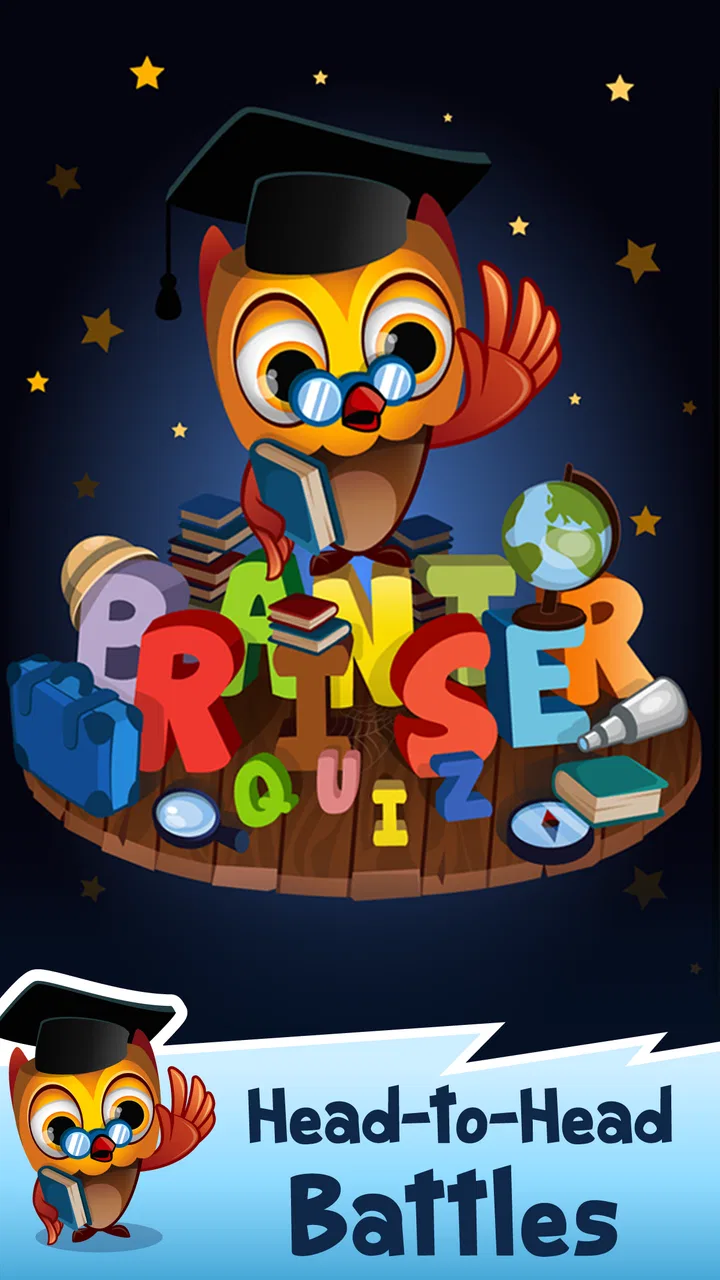
Brainster Quiz
- 4.8
- Rating
- 100.00K
- Installs
- Free
- Price

 Analysis by App-foxy
I went into Brainster Quiz expecting a familiar trivia format, but what kept me playing was how quickly it turns a single question into a small contest. You choose an answer, see the result, measure yourself against the other side, and almost immediately have a reason to try again. That simple rhythm is the heart of this free trivia game from Aparteko Games.
The basic appeal is easy to understand: outsmart your opponent in short quiz rounds rather than settle into a long, complicated campaign. It suits the moments when I have enough attention for a challenge but not enough time for a large game. A waiting room, a coffee break, or the final few minutes before bed can all become a quick test of memory and judgment.
Brainster Quiz has been available since May 21, 2015, and its current version is 1.46. It is rated for Everyone and runs on Android 5.0 or later. Those details make it accessible to a wide range of players, including families looking for something more thoughtful than an action game.
You May Also Like

 Blood Strike: 2.5 Anniversary
Blood Strike’s Loadouts Turn Every Drop Into a Tactical Gamble
A close look at Blood Strike’s custom loadouts: how fast access to signature weapons reshapes its battle royale rhythm, rewards preparation, and narrows the gap between fights.

 Pandora - Music & Podcasts
Pandora’s Music Is Easy to Start, but Harder to Recover
Pandora’s strength is its low-effort path from a seed to a station. Its weak spot is how much confidence it asks you to place in connection, setup, and quiet recovery.

 8 Ball Pool
 Is Built on Rivalries, Rematches, and Routine
A close look at the rivalries, rematches, shared routines, and unanswered safety questions that turn a quick pool match into a persistent mobile community.

 Samsung Music
’s Quiet Strength Is Playing What You Already Own
Its reach comes less from spectacle than from dependable access to a personal library. That simplicity is both the app’s strongest retention engine and its ceiling.

 AccuWeather: Weather Radar
AccuWeather Review: A Quick, Clear Forecast for Everyday Decisions
For everyday plans, the best forecast is the one you can understand quickly. AccuWeather makes rain timing, radar, and local conditions easy to act on, with a few trade-offs.

 Hill Climb Racing
Why Hill Climb Racing Still Turns Crashes Into One More Run
A tiny car, a bumpy hill and one more upgrade: Hill Climb Racing keeps resurfacing because its simple chaos makes every near-miss feel personal.
More From Our News Desk
View All News


How the quiz loop turns one answer into another round
I find the quiz loop most satisfying when I treat each answer as a decision to learn from, not just a chance to score. A close result can point me toward a better habit for the next round—reading the full question, ruling out weak choices, or pausing before I tap. That small reset is what keeps the contest feeling fresh, and it also makes clear where the game’s quick format may start to feel repetitive.
The first action is deliberately simple
The first thing I like about the game is that it does not ask me to learn a complicated control scheme. The important action is choosing an answer under the pressure of a head-to-head trivia challenge. That keeps my attention on the question itself, not on menus, movement, or a collection of systems that need explaining.
That simplicity also makes the game approachable for casual players. Someone who rarely plays mobile games can understand the objective quickly: read, decide, tap, and see whether the choice holds up. At the same time, the opponent-based format gives each answer more weight than a private practice quiz. I am not merely checking whether I know something; I am trying to make the better decision in a contest.
My advice is to treat the opening questions as a calibration period. Do not rush just because the interface feels quick. Read the wording carefully, especially when two options seem almost interchangeable. In trivia, the most obvious answer is not always the precise answer, and a fast guess can be worse than taking a moment to eliminate the choices that clearly do not fit.
This is one of the game’s less obvious strengths: it rewards attention without requiring a long commitment. I can start a session casually, but the presence of an opponent encourages me to switch from passive tapping to active reasoning. That change is what gives the first action its energy.
Feedback arrives at the right moment
After choosing, the game’s feedback determines whether I want to continue. Brainster Quiz works because the result is not separated from the decision by a long detour. I find out whether my answer helped or hurt, and that information immediately changes how I approach the next question.
A correct answer gives a small burst of confidence, but it also creates a new problem: can I maintain the advantage? A wrong answer is more useful than it first appears because it exposes a gap in my knowledge or a mistake in my reading. Instead of treating failure as the end of the experience, I can use it to adjust my pace and become more selective.
The opponent changes the emotional texture of that feedback. In a solo quiz, a wrong answer may feel like a private score correction. Here, it feels like lost ground. That makes even familiar subjects more engaging, because I am watching the result in relation to another player rather than judging an isolated total.
I found that the best way to use the feedback is to separate knowledge mistakes from decision mistakes. If I genuinely did not know the answer, I can remember the subject or fact for later. If I knew the material but tapped too quickly, the lesson is different: slow down before the next choice. This distinction makes the game more valuable than simply replaying questions until a score improves.
The reward is the rematch itself
Brainster Quiz does not need an elaborate reward structure to create motivation. The immediate reward is the feeling of winning a close exchange, followed by the curiosity of seeing whether I can do it again. A good run gives me confidence; a poor run creates a clear reason to start another attempt.
That loop is especially effective for people who enjoy competition but do not want the intensity of a fast action game. The pressure comes from knowledge and timing, not from reflexes. I can play while sitting comfortably, yet the next answer still matters because the opponent gives every decision context.
There is also a useful social quality to the format, even when I am not treating it as a serious competition. It is easy to imagine using a quiz match as a light challenge between friends or family members. The game’s Everyone rating supports that broad appeal, although players should still remember that trivia ability can vary sharply by age, education, language, and personal interests.
The reward is less satisfying for someone who wants a deep progression system, a story, or a large collection of character upgrades. This is not the kind of game I would choose when I want to build something over many hours. Its pleasure is concentrated in the question, the answer, and the result. If that core exchange does not interest you, extra play will not transform it into a different genre.
Why another session begins
The reason I return is not simply that the rounds are short. It is the combination of unfinished knowledge and unfinished competition. A close loss makes me want to prove that the result was not representative, while a win makes me curious whether I can repeat it against a different set of questions or a more difficult opponent.
This is a healthier reason to replay than blindly chasing a larger number. I can begin the next session with a specific goal: read more carefully, avoid guessing from the first impression, or recover after an early mistake. Those small goals give the reset some purpose.
One practical routine works particularly well for me. I play a session during a short break, notice which questions caused trouble, and then return later when I am in the mood for another challenge. I do not treat every result as a verdict on my intelligence. Trivia covers too many subjects for one round to measure everything, and keeping that perspective makes the game more enjoyable.
Players who prefer predictable progress may find the reset less appealing. The game’s central pleasure comes from repeating the contest, not from permanently removing the need to answer questions. That makes it replayable, but it can also feel cyclical if I am looking for a strong sense of completion.
Where it fits beside ordinary quiz alternatives
Compared with a standard solo trivia app, Brainster Quiz feels more immediate because the opponent gives my answer a competitive purpose. A solo format is usually better when I want to study at my own pace, review a particular subject, or concentrate on learning without pressure. This game is better when I want the same basic knowledge test to feel like a contest.
Compared with broad party quiz games, it is a more convenient choice for a quick individual session. Party titles often work best when several people are physically together and ready to laugh at mistakes. Brainster Quiz is easier to pick up when I am alone with my phone, though it does not replace the atmosphere of a group game.
It also differs from fast arcade games because the main skill is not reaction speed. If you enjoy thinking through wording, recalling facts, and making decisions with limited time, the format should feel natural. If you prefer constant visual action or direct control over a character, the lack of movement may make it feel restrained.
That comparison helped me understand the game’s proper role. I would not install it as a complete replacement for every trivia experience. I would choose it as a compact competitive option: something to open when I want my brain engaged and want the result to matter immediately.
Small habits that improve the experience
The first useful habit is to read the entire question before looking for the answer that feels familiar. Trivia often uses recognition to lure a quick response, and the final words can change what is being asked. A slower first read is more valuable than trying to compensate after tapping.
The second is to use elimination rather than relying only on instant recall. Even when I do not know the answer with certainty, removing obviously unsuitable choices can turn a blind guess into a reasoned decision. That approach is particularly useful when the opponent’s presence makes me want to answer too quickly.
The third is to review the emotional result, not only the factual result. If a loss makes me play recklessly in the next session, the game becomes frustrating. I get more from it when I use the reset to change one behavior at a time, such as slowing down or refusing to let one wrong answer dictate the rest of the round.
A fourth trade-off concerns spending. The game is free to download, while in-app purchases range from $1.99 to $49.99 per item. I would start without buying anything and decide only after I understand whether the basic quiz loop already gives me enough value. Anyone managing a child’s device should also be aware that optional purchases can matter even when the game itself costs nothing.
Who should play and who should skip it
I recommend Brainster Quiz to players who enjoy short competitive challenges, especially those who like trivia but lose interest in long solo tests. It is also a sensible choice for families seeking an Everyone-rated game that focuses on knowledge rather than violence or complex controls. The accessible Android requirement means it can work on older devices that cannot handle demanding modern games.
The game is less suitable for someone who wants a structured educational course. It may encourage curiosity and expose knowledge gaps, but I would not use it as a substitute for a textbook, a language-learning program, or a subject-specific study tool. The contest format prioritizes momentum and replay value over detailed explanations.
I would also skip it if I strongly dislike repeated rounds or competitive pressure. The reason to begin again is built into the tension between answer and result. Players who want a calm, fully controlled pace may prefer a solo quiz, while players seeking a persistent world should look toward a role-playing or strategy game instead.
My verdict on the action-feedback-reward-reset cycle
After spending time with it, I see Brainster Quiz as a focused trivia game rather than an oversized all-purpose entertainment app. Its action is clear, its feedback is immediate, its reward is the satisfaction of gaining or recovering an advantage, and its reset works because each new session offers another chance to make a better decision.
The format is not flawless. Repetition can become noticeable for players who need constant novelty, and the competitive framing will not appeal to everyone. The optional purchase range also means I would pay attention before spending, particularly on a shared device. Those are real considerations, not reasons to dismiss the game.
Its strongest quality is that it makes ordinary knowledge feel active. I am not just answering questions into an empty score screen; I am reacting to an opponent, interpreting feedback, and deciding whether the next attempt deserves another chance. With an average rating of 4.8 from around 3.8 thousand ratings and more than 100 thousand installs, it has clearly found an audience for that compact challenge.
For me, the best way to approach it is as a quick mental duel. Open it when you want a break that still asks something of you, play thoughtfully instead of tapping on impulse, and let each result teach you how to handle the next round. If that action-feedback-reward-reset pattern sounds appealing, this free trivia game is worth trying; if you need a deeper progression system or a dedicated learning tool, another category will serve you better.
FAQs for Brainster Quiz
01What is Brainster Quiz and how does the game work?
Brainster Quiz is a trivia-style mobile game designed to test your knowledge across different subjects. After starting a quiz, you answer multiple-choice questions within the available time or round limit. Correct answers usually help you progress, while mistakes can reduce your score or end the attempt. The game is suitable for short sessions and casual players who enjoy learning while competing.
02What categories and difficulty levels are available in Brainster Quiz?
Brainster Quiz typically offers questions from several general-knowledge categories, such as history, science, geography, entertainment, sports, and everyday facts. The exact selection may vary depending on the version or available quiz packs. Some questions feel accessible to beginners, while others are more challenging, so the experience can appeal to both casual players and users looking for a stronger mental test.
03Does Brainster Quiz require an internet connection to play?
An internet connection may be needed for downloading the game, loading certain quizzes, synchronizing progress, displaying advertisements, or accessing online features. Some portions of the game may remain available offline after installation, but this can depend on the device, app version, and content already downloaded. Before traveling or playing without mobile data, it is worth testing the game offline.
04Is Brainster Quiz free to download, and are there advertisements or in-app purchases?
Brainster Quiz can generally be downloaded without an upfront payment, but free access may be supported by advertisements or optional purchases. Ads may appear between rounds or while unlocking additional content, depending on the platform and current release. If the app offers paid features, review the purchase details carefully, especially if children will use the device or account.
05Is Brainster Quiz suitable for children and family play?
Brainster Quiz can be appropriate for family use when the questions match the player’s age and reading ability. However, trivia content, advertisements, language, and difficulty may vary, so parents should check the store listing and review the game themselves before allowing younger children to play. If the app includes online rankings, purchases, or external links, parental supervision is recommended.
Pros
- Wide range of trivia topics keeps quizzes varied and engaging.
- Short rounds make it easy to play during quick breaks.
- Simple interface is accessible for casual players of all ages.
- Progress tracking encourages regular play and personal improvement.
- Competitive elements can add motivation for trivia fans.
Cons
- Some questions may feel too easy for experienced quiz players.
- Question difficulty and accuracy can vary between categories.
- Repeated questions may appear after extended play sessions.
- Competitive features may be less enjoyable without active opponents.
- Requires internet access for some features or quiz content.

Brainster Quiz
Gallery